
Weekly · monthly · annual
Nanny pay calculator
Gross pay for a nanny’s week, with overtime the way federal and state rules count it.
Nanny gross pay estimate
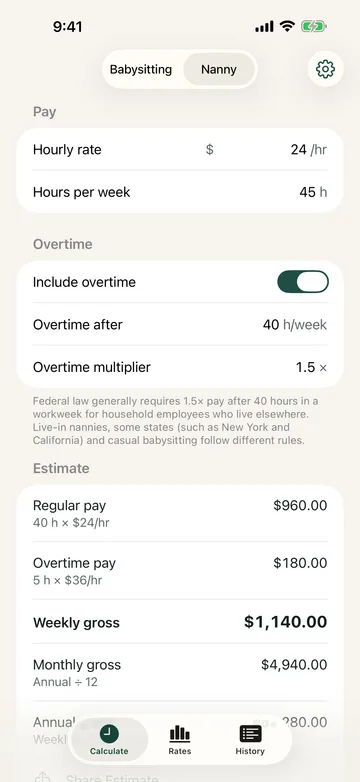
- Regular hours40 h × $24/hr
- $960.00
- Overtime5 h × $36/hr (1.5×)
- $180.00
- Weekly gross
- $1,140.00
- Monthly grossAnnual ÷ 12, not weekly × 4
- $4,940.00
- Annual grossWeekly × 52
- $59,280.00
- At this pay, 2026 household-employer taxes (Social Security and Medicare) apply once cash wages reach $3,000 in the year.
Gross-pay estimate only. Tax and employment rules vary by location and situation.
Employ a nanny and a sitter? SitterRate Pro has this estimator next to the babysitting calculator, and keeps your sitters and payment history in one place.
 Get SitterRateFree on the App Store · iPhone
How much to pay a nanny in 2026
Sittercity puts the typical hourly rate for nannies at $25 nationally (provider data, May 2026). Care.com’s 2026 Cost of Care Report, built from rates families posted, puts a nanny for one infant at $870 a week for 40 hours.
You will also see $26.24 an hour quoted as a national nanny rate. That figure is UrbanSitter’s 2026 average for babysitting one child, not a nanny rate.
Local pay varies a lot. Compare your area’s childcare wages with the U.S. median on the state pages.
- Regular40 h × $24/hr
- $960.00
- Overtime5 h × $36/hr
- $180.00
- Weekly gross
- $1,140.00
Monthly $4,940.00 · annual $59,280.00
Overtime rules for nannies
Federal law
Nannies are domestic service employees under the Fair Labor Standards Act. They must be paid at least the federal minimum wage, and 1.5 times their regular rate for hours over 40 in a workweek for the same employer.
Live-in nannies are exempt from federal overtime but not from minimum wage. The Department of Labor counts someone as live-in if they live, work and sleep in your home five days a week (120 hours or more), or permanently.
Casual babysitters (occasional, usually 20 hours a week or less, not their vocation) are exempt from both.
States with their own rules
- New York Domestic Workers' Bill of Rights: Overtime at 1.5× the regular rate after 40 hours a week, or after 44 hours for workers who live in the employer's home.
- California Domestic Worker Bill of Rights: A nanny whose work is mainly supervising, feeding and dressing children (a “personal attendant”) earns overtime after 9 hours in a day or 45 hours in a week.
- Massachusetts Domestic Workers Bill of Rights: Nanny services are domestic work; overtime applies after 40 hours a week.
- Hawaii domestic workers: Household employers must pay domestic workers minimum wage and overtime after 40 hours a week, live-in or live-out.
- Illinois Domestic Workers' Bill of Rights: Domestic workers are covered by the Illinois Minimum Wage Law even when a household employs only one worker.
- Oregon Domestic Workers' Protection Act: Overtime after 40 hours a week, or after 44 hours for a worker who lives in the home.
- Nevada Domestic Worker's Bill of Rights: Domestic workers earn at least the state minimum wage for all working time, including on-duty sleep and meal periods.
How the estimate is calculated
The calculator uses the same rules as the nanny estimator in the SitterRate app:
- Regular hours are the hours up to the overtime threshold; overtime hours are the rest.
- Regular pay is regular hours × the hourly rate, rounded to the cent once.
- Overtime pay is overtime hours × the rate × the multiplier, rounded once. The overtime rate is shown rounded but never rounded before multiplying.
- Annual gross is weekly × 52; monthly gross is annual ÷ 12.
- Regular40 h × $20.33/hr
- $813.20
- Overtime5.5 h × $30.495/hr
- $167.72
- MonthlyAnnual ÷ 12
- $4,250.65
- Weekly gross
- $980.92
When nanny taxes start
If you pay one household employee $3,000 or more in cash wages in 2026, Social Security and Medicare taxes apply: 7.65% from you and 7.65% withheld from the nanny. Federal unemployment tax applies if you pay household employees $1,000 or more in any calendar quarter. A full-time nanny passes both within weeks.
Read babysitter and nanny taxes for 2026, or the IRS’s Publication 926. Many families use a household payroll service.
SitterRate for iPhone
Nanny pay next to your sitters
SitterRate Pro includes this estimator alongside the babysitting calculator, the overnight split and your payment history.
- Weekly, monthly and annual gross pay with configurable overtimePro
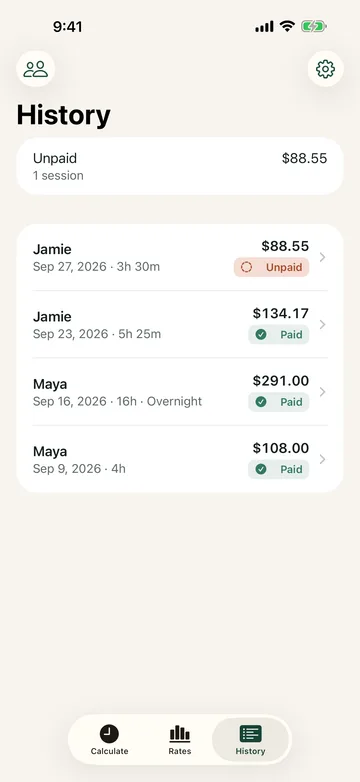
- Live timer for sessions, with paid/unpaid history
- Save each caregiver's rate and rules
- Plain-text and PDF summaries to sharePro
Get SitterRateFree on the App Store · iPhoneFree download. Pro is a one-time in-app purchase, with no subscription. What’s in the app
Questions people ask
How much should I pay a nanny per week?
Multiply the hourly rate by the hours, then add overtime. At $24 an hour for 45 hours, that is 40 × $24 + 5 × $36 = $1,140.00 a week. Care.com's 2026 Cost of Care Report puts the average posted cost of a nanny for one infant at $870 a week for 40 hours.
Do nannies get overtime?
Yes, under federal law, unless they live in your home: 1.5 times their regular rate for hours over 40 in a workweek. Some states go further, such as New York (overtime after 44 hours for live-in workers) and California (after 9 hours a day or 45 a week for nannies whose work is mainly childcare).
Do live-in nannies get overtime?
Not under federal law, which exempts domestic workers who live in the employer's home from overtime. They must still be paid at least minimum wage for every hour worked. Several states require overtime for live-in workers anyway, including New York and Oregon after 44 hours.
Is monthly nanny pay weekly pay × 4?
No. A year has 52 weeks, not 48, so weekly × 4 understates pay. The calculator, like the SitterRate app, works out annual pay as weekly × 52 and monthly pay as annual ÷ 12.
Does this include taxes?
No. It estimates gross pay only. If you pay a household employee $3,000 or more in cash wages in 2026, you owe Social Security and Medicare taxes (7.65% employer share, and you withhold the same from the employee) and may owe federal unemployment tax. See IRS Publication 926 or a household payroll service.
What are guaranteed hours?
A promise in your nanny agreement to pay for a set number of hours each week even if you need fewer. It is a contract term families and nannies negotiate, not a legal requirement in most places.
Sources
- Sittercity, “Average Babysitter & Nanny Pay Rates by US City,” Sittercity provider data, May 2026.Nanny and babysitter national rates.
- Care.com, 2026 Cost of Care Report (published February 3, 2026)
- 29 CFR Part 552: domestic service employment
- U.S. Department of Labor, Fact Sheet #79B: live-in domestic service workers
- IRS Publication 926 (2026), Household Employer's Tax Guide