
Rate guide · 2026
Babysitting rates 2026: how much to pay a babysitter
Three national sources, what each one measures, and what a night out actually costs at those rates.
Short answer
For one child, U.S. families can expect to pay about $20 to $26 an hour in 2026, about $30 for two children and about $32 for three. Expect the higher end in big, high-cost cities, for infants, and for sitters who drive or take on extra duties.
The three national numbers, and why they differ
| Source | 1 child | 2 kids | 3 kids |
|---|---|---|---|
| Care.comAverage posted starting rate of sitters listed on Care.com · Feb 12, 2026 | $19.81 | — | — |
| SittercityTypical rate listed by sitters on Sittercity · May 2026 | $23.00 | — | — |
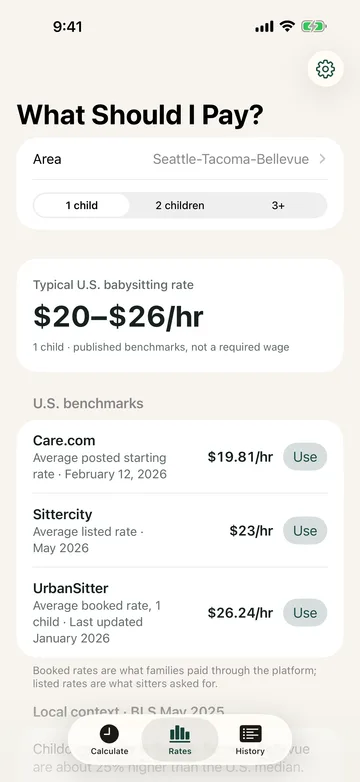
| UrbanSitterAverage pay from completed bookings · January 2026 | $26.24 | $29.87 | $32.33 |
Posted and listed rates are what sitters ask for. Care.com’s figure is a starting rate, so it runs lowest.
Booked rates are what families actually paid through UrbanSitter. Its national average is higher than most of the city averages it publishes, and its weighting isn’t disclosed, so treat it as the top of the typical range rather than the going rate everywhere.
None of these is a required or “fair” wage. We show them side by side rather than averaging them, because they measure different things.
Only UrbanSitter splits its figures by the number of children, which is why the two- and three-child columns have a single source.
What a night costs at 2026 rates
Base pay before any tip, rounded to the dollar. One child is priced from Care.com’s posted starting rate up to UrbanSitter’s booked average; two and three kids use UrbanSitter’s averages. A typical date night of about 4 hours with one child runs $79.24 to $104.96.
| Hours | 1 child$19.81–$26.24/hr | 2 kids$29.87/hr | 3 kids$32.33/hr |
|---|---|---|---|
| 3 hours | $59–$79 | $90 | $97 |
| 4 hours | $79–$105 | $119 | $129 |
| 5 hours | $99–$131 | $149 | $162 |
| 6 hours | $119–$157 | $179 | $194 |
| 8 hours | $158–$210 | $239 | $259 |
Compare your area
No source publishes babysitting rates for every area that we are allowed to show. What we can show is how local childcare wages compare with the U.S. median, for 573 metro, rural and state areas. If your area is 20% above the median, expect to pay toward the top of the national range.
Typical U.S. babysitting rate, 1 child
$20–$26/hr
Care.com, Sittercity and UrbanSitter, 2026.
Local context
Search for your area to compare local childcare wages with the U.S. median. No location access needed.
When to pay toward the higher end
These come up again and again in the sources. They are reasons to start higher, not formulas:
- An infant. Care.com suggests $1 to $2 more an hour; UrbanSitter says families often pay more for newborn and toddler care.
- Three or more children. See rates for more kids.
- Driving. Reimburse gas separately; Care.com notes a sitter using their own car needs fuel money.
- Special needs or specialized experience. Certifications or an early-childhood degree, for example.
- Extra duties. Homework help, meals or household tasks on top of childcare.
- Late nights, holidays and short notice. New Year’s Eve is the classic premium night.
Other kinds of care
- Two, three or more kidsMeasured increases vs. rules of thumb, and infants.
- Overnight and sleepover ratesFlat overnight fees vs. paying every hour.
- Full-day and summer carePer day, per week and after school.
- Teen babysittersWhat to pay a 12- to 17-year-old.
- Nanny payWeekly gross pay with overtime.
What childcare-worker wages tell you, and what they don’t
The U.S. Bureau of Labor Statistics publishes wages for childcare workers in every state and metro area. The national median for May 2025 is $16.82/hr, with the middle half earning $14.12 to $18.55/hr.
That is below every national babysitting figure above, and for a reason: the survey covers employed childcare workers in centers, schools and organizations, and excludes private households and the self-employed, which is where most babysitters work. So the BLS numbers are good for one thing: telling you whether your area pays more or less than the country as a whole.
SitterRate for iPhone
Carry the rate guide in your pocket
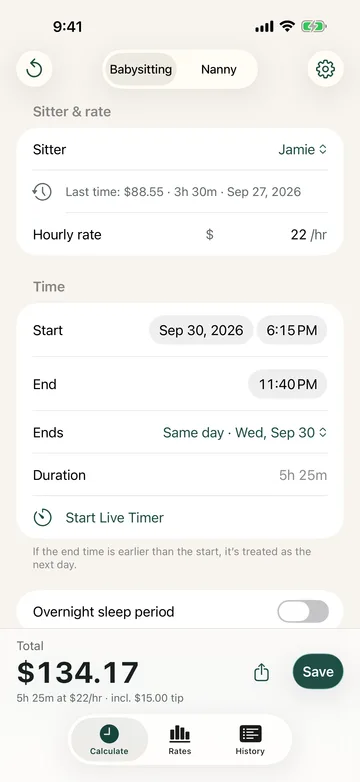
The SitterRate app has the same sourced benchmarks and local context for about 570 areas, works offline and never asks for your location. Tap a rate to use it in the calculator.
- Every figure shows its source, what it measures and the date
- Choose your area from a searchable list, with no location access
- Use a benchmark rate in the calculator with one tap
- Save each sitter's agreed rate for next time
 Get SitterRateFree on the App Store · iPhone
Free download. Pro is a one-time in-app purchase, with no subscription. What’s in the app
Questions people ask
What is the average babysitter rate in 2026?
It depends on what is measured. Families paid an average of $26.24/hr for one child through UrbanSitter (booking data, January 2026). Sittercity puts the typical listed rate at $23/hr (May 2026), and Care.com sitters post an average starting rate of $19.81/hr (February 2026). Most families land somewhere between about $20 and $26 an hour for one child.
How much should I pay a babysitter for 4 hours?
At typical 2026 rates, 4 hours with one child costs about $79.24 to $104.96, before any tip. With two children at UrbanSitter's average of $29.87/hr, it is $119.48.
How much more do you pay for two kids?
In UrbanSitter's 2026 booking data the average rose from $26.24/hr for one child to $29.87/hr for two (about $3.63 more) and $32.33/hr for three. Care.com suggests adding $0.50 to $1 an hour per extra child, and Sittercity $1 to $2.
Do babysitters charge more on holidays or late at night?
Often, yes. Care.com notes sitters may ask more for weekend nights, holidays and last-minute jobs, and Sittercity says to expect to pay more on New Year's Eve and Valentine's Day. No source we use publishes a standard late-night premium, so agree on it in advance.
Are the local childcare wages here what babysitters charge?
No. They are U.S. Bureau of Labor Statistics wages for employed childcare workers, mostly in daycare centers and schools. The survey excludes private-household and self-employed workers, so private babysitters usually charge more. They are useful for comparing areas, not as a babysitting rate.
Is $15 an hour good pay for a babysitter?
It is below every 2026 national babysitting benchmark we track (the lowest is Care.com's $19.81/hr posted starting rate), though rates are lower in some areas and for younger sitters. Compare your area's childcare wages with the U.S. median using the lookup above.
Sources
- UrbanSitter, “Babysitting Rates by City (2026),” last updated January 2026.
- Sittercity, “Average Babysitter & Nanny Pay Rates by US City,” Sittercity provider data, May 2026.
- Care.com, “How much does a babysitter cost?” updated February 12, 2026.
- U.S. Bureau of Labor Statistics, Occupational Employment and Wage Statistics, May 2025.Childcare Workers (SOC 39-9011), hourly wage percentiles.
- BLS, OEWS technical notes (scope of the survey)