
Minnesota · 2026
Babysitting rates in Minnesota
What families pay nationally, how Minnesota wages compare, and the pay rules that apply in the state.
Short answer
Expect the middle of the national range of $20–$26 an hour for one child. Childcare workers in Minnesota earn a median of $17.08/hr, about 2% higher than the U.S. median of $16.82/hr.
Minnesota childcare wages at a glance
- Median, Minnesota
- $17.08/hr
- Compared with the U.S.
- +2%
- Middle half earn
- $14.59–$18.50
- Rank among 50 states and D.C.
- 19 of 51
Areas in Minnesota
Childcare wages run from $13.48/hr in Sioux Falls to $17.46/hr in Minneapolis-St. Paul-Bloomington. In the higher-wage areas, expect babysitting rates toward the top of the national range.
| Area | Median, per hour | vs. U.S. |
|---|---|---|
| Minneapolis-St. Paul-BloomingtonMetro area · MN–WI | $17.46 | +4% |
| MankatoMetro area | $16.63 | −1% |
| RochesterMetro area | $16.59 | −1% |
| St. CloudMetro area | $16.36 | −3% |
| Northwest Minnesota (nonmetro area)Rural (nonmetro) area | $15.68 | −7% |
| Northeast Minnesota (nonmetro area)Rural (nonmetro) area | $15.50 | −8% |
| Southeast Minnesota (nonmetro area)Rural (nonmetro) area | $15.00 | −11% |
| DuluthMetro area · MN–WI | $14.89 | −11% |
| La Crosse-OnalaskaMetro area · WI–MN | $14.77 | −12% |
| Southwest Minnesota (nonmetro area)Rural (nonmetro) area | $14.71 | −13% |
| Grand ForksMetro area · ND–MN | $14.53 | −14% |
| FargoMetro area · ND–MN | $14.44 | −14% |
| Sioux FallsMetro area · SD–MN | $13.48 | −20% |
Pay rules in Minnesota
Minimum wage. Minnesota's minimum wage is $11.41 an hour, in effect since January 1, 2026. Scheduled to rise to $11.87 on January 1, 2027.
Casual babysitting (irregular or occasional, usually 20 hours a week or less, and not the sitter’s vocation) is exempt from the federal minimum wage and overtime. Nannies and regular sitters are covered: at least $11.41/hr for every hour under Minnesota law where it applies, and never less than the federal $7.25, plus overtime at 1.5× after 40 hours in a week unless they live in your home.
Use it tonight
Pick a rate, then work out exactly what you owe, including past-midnight endings, extra kids and a tip.
- Babysitter pay calculatorStart and end time, rate, kids and tip.
- Rates for two or more kids$29.87/hr nationally for two children.
- Nanny pay calculatorWeekly gross pay with overtime.
- Babysitter taxes in 2026When household-employer taxes apply.
Compare with other states
- New MexicoNext higher median: $17.23/hr (about 2% higher than the U.S.)
- MontanaNext lower median: $16.89/hr (about the same as the U.S.)
- All statesChildcare wages and minimum wages for the 50 states and D.C.
- National babysitting rates 2026Care.com, Sittercity and UrbanSitter, side by side.
SitterRate for iPhone
Minnesota areas, in the app
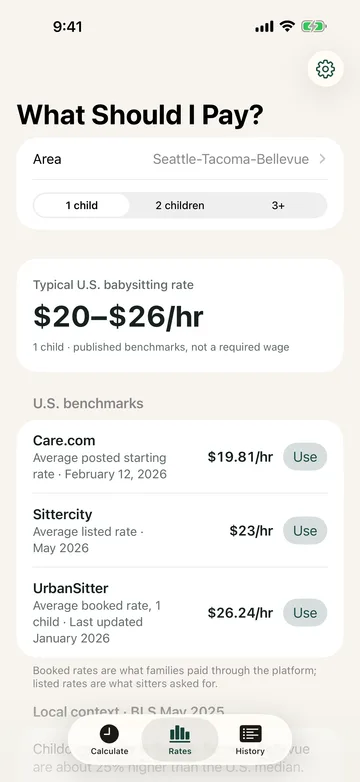
SitterRate's Rate Guide includes all 13 Minnesota areas listed here alongside the national benchmarks, works offline, and never asks for your location.
- Pick your area once; the app remembers it
- Use a rate in the calculator with one tap
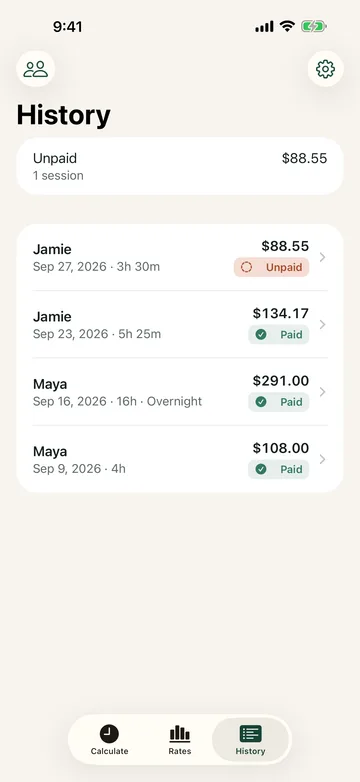
- Save each sitter's agreed rate and see what you paid last time
- Keep a simple paid/unpaid history
 Get SitterRateFree on the App Store · iPhone
Free download. Pro is a one-time in-app purchase, with no subscription. What’s in the app
Minnesota: common questions
How much do babysitters charge in Minnesota?
No source publishes a babysitting rate for Minnesota that we can show. Nationally, families pay about $20 to $26 an hour for one child in 2026. Childcare workers in Minnesota earn a median of $17.08/hr, about 2% higher than the U.S. median, which points toward the middle of the national range.
What is the minimum wage for a babysitter in Minnesota?
Minnesota's minimum wage is $11.41 an hour, in effect since January 1, 2026. Under federal law, babysitters working on a casual basis (irregular, usually 20 hours a week or less, and not their vocation) are exempt from minimum wage and overtime; regular sitters and nannies are not. Scheduled to rise to $11.87 on January 1, 2027.
Do nannies in Minnesota get overtime?
Under federal law, nannies who don't live in the employer's home earn 1.5× their regular rate after 40 hours in a workweek. Live-in nannies are exempt from federal overtime but must still be paid at least minimum wage for every hour worked.
Sources
- U.S. Bureau of Labor Statistics, Occupational Employment and Wage Statistics, May 2025.Childcare Workers (SOC 39-9011), state and area wage percentiles.
- U.S. Department of Labor, State Minimum Wage Laws (updated July 1, 2026)Checked against state sources on October 1, 2026.
- 29 CFR Part 552: domestic service, including casual babysitting
- UrbanSitter, “Babysitting Rates by City (2026),” last updated January 2026.
- Sittercity, “Average Babysitter & Nanny Pay Rates by US City,” Sittercity provider data, May 2026.
- Care.com, “How much does a babysitter cost?” updated February 12, 2026.